
Introduction
In the banking and financial sector, loan assets are classified based on their repayment performance and risk level. One of the important categories under this classification is the Sub-Standard Asset (SSA). This classification plays a crucial role in determining the financial health of banks and NBFCs and helps regulators monitor credit risk in the economy.
A loan becomes a sub-standard asset when it remains non-performing for a certain period but is not yet classified as a “doubtful” or “loss” asset. Understanding sub-standard assets is essential for banks, financial institutions, borrowers, and investors because it directly affects credit decisions, provisioning norms, and recovery strategies.
In this blog, we will explain what a sub-standard asset is, how it is classified, its impact on banks, and the recovery process in detail.
Click Here to Get a Loan For NPA Accounts
What is a Sub-Standard Asset?
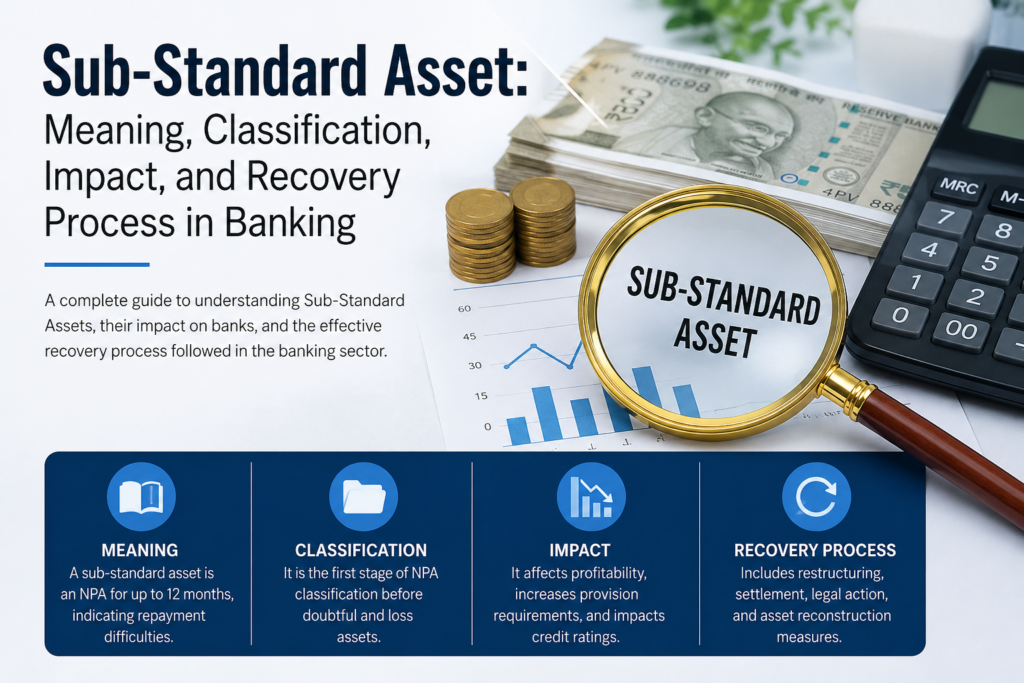
A Sub-Standard Asset (SSA) is a loan or advance that has remained a Non-Performing Asset (NPA) for a period of up to 12 months.
In simple terms:
- When a borrower fails to repay principal or interest for more than 90 days, the loan becomes an NPA.
- If this NPA continues for up to 12 months, it is classified as a sub-standard asset.
At this stage, the asset shows clear signs of repayment weakness, but there is still a possibility of recovery.
Key Characteristics of Sub-Standard Assets
Sub-standard assets generally have the following features:
- Loan remains NPA for less than 12 months
- High risk of default but not completely written off
- Partial recovery is still possible
- Requires higher provisioning from banks
- Borrower shows weak financial performance or cash flow issues
These assets indicate early credit deterioration and are considered warning signals for financial institutions.
Classification of Sub-Standard Assets
Banking regulations (as per RBI guidelines in India) classify assets into three main categories under NPAs:
1. Sub-Standard Assets
- NPA period: Up to 12 months
- Risk level: Moderate
- Recovery chances: Possible
2. Doubtful Assets
- NPA period: More than 12 months
- Risk level: High
- Recovery chances: Uncertain
3. Loss Assets
- No recovery expected
- Fully written off by banks
- Very high risk
Sub-standard assets are the first stage of serious loan deterioration.
Reasons for an Asset Becoming Sub-Standard
There are multiple reasons why a loan account becomes sub-standard:
1. Business Losses
Borrowers may face financial losses due to market conditions, poor management, or low demand.
2. Economic Slowdown
A slowdown in the economy can affect repayment capacity of businesses and individuals.
3. Poor Credit Planning
Improper loan structuring or unrealistic repayment plans can lead to default.
4. Operational Issues
Cash flow mismatches or delayed receivables can impact loan repayment.
5. External Factors
Natural disasters, regulatory changes, or industry disruptions can also affect repayment ability.
Impact of Sub-Standard Assets on Banks
Sub-standard assets have a direct impact on the financial health of banks and NBFCs.
1. Increased Provisioning Requirement
Banks are required to set aside a portion of funds as a safety buffer, reducing profitability.
2. Reduced Profitability
Higher NPAs reduce the income generated from interest.
3. Capital Pressure
More sub-standard assets reduce the lending capacity of banks.
4. Credit Rating Impact
A rise in bad assets can negatively affect a bank’s credit rating.
5. Operational Stress
Banks need additional resources for recovery and legal actions.
Provisioning Norms for Sub-Standard Assets
Banks are required to make provisions (set aside funds) for potential losses.
Typical provisioning structure includes:
- Secured loans: Lower provision percentage
- Unsecured loans: Higher provision percentage
Provisioning ensures that banks are protected from potential losses arising from defaulting borrowers.
Recovery Process of Sub-Standard Assets
Recovery of sub-standard assets is a critical function for banks and financial institutions. Several methods are used:
1. Restructuring of Loans
Banks may restructure repayment schedules to help borrowers repay the loan.
2. One Time Settlement (OTS)
A negotiated settlement where the borrower pays a lump sum amount to close the loan.
3. Legal Recovery Actions
Banks may initiate legal proceedings under debt recovery laws.
4. Asset Reconstruction Companies (ARCs)
Banks may sell bad loans to ARCs for recovery.
5. Loan Takeover or Refinancing
In some cases, loans may be refinanced by other financial institutions.
Difference Between NPA and Sub-Standard Asset
Many people confuse NPA with sub-standard assets.
- NPA: A loan becomes non-performing after 90 days of non-payment
- Sub-Standard Asset: An NPA that has remained in that category for up to 12 months
👉 So, every sub-standard asset is an NPA, but not every NPA is sub-standard at the beginning stage.
Importance of Monitoring Sub-Standard Assets
Monitoring these assets helps in:
- Early identification of credit risk
- Better loan recovery planning
- Financial stability of banks
- Preventing further deterioration into doubtful or loss assets
Proper monitoring ensures that financial institutions remain stable and profitable.
Conclusion
A Sub-Standard Asset is an early stage of loan deterioration that signals financial stress in a borrower’s account. While it is still recoverable, it requires careful monitoring, restructuring, and proactive recovery strategies.
For banks and NBFCs, managing sub-standard assets efficiently is crucial for maintaining profitability and financial stability. For borrowers, understanding this classification helps in taking corrective financial actions before the situation worsens.
In today’s dynamic financial environment, effective management of sub-standard assets plays a key role in maintaining a healthy credit ecosystem and ensuring long-term economic stability.